
Sandcross Primary
School

SEND
At Sandcross, inclusion is not a programme or a provision - it is part of who we are. Every decision we make begins with one question: "Is this making a positive difference for the child?" Together, we will continue striving to ensure that every child belongs, learns and flourishes.
Our Inclusive Support Offer
Sandcross Primary School and Nursery
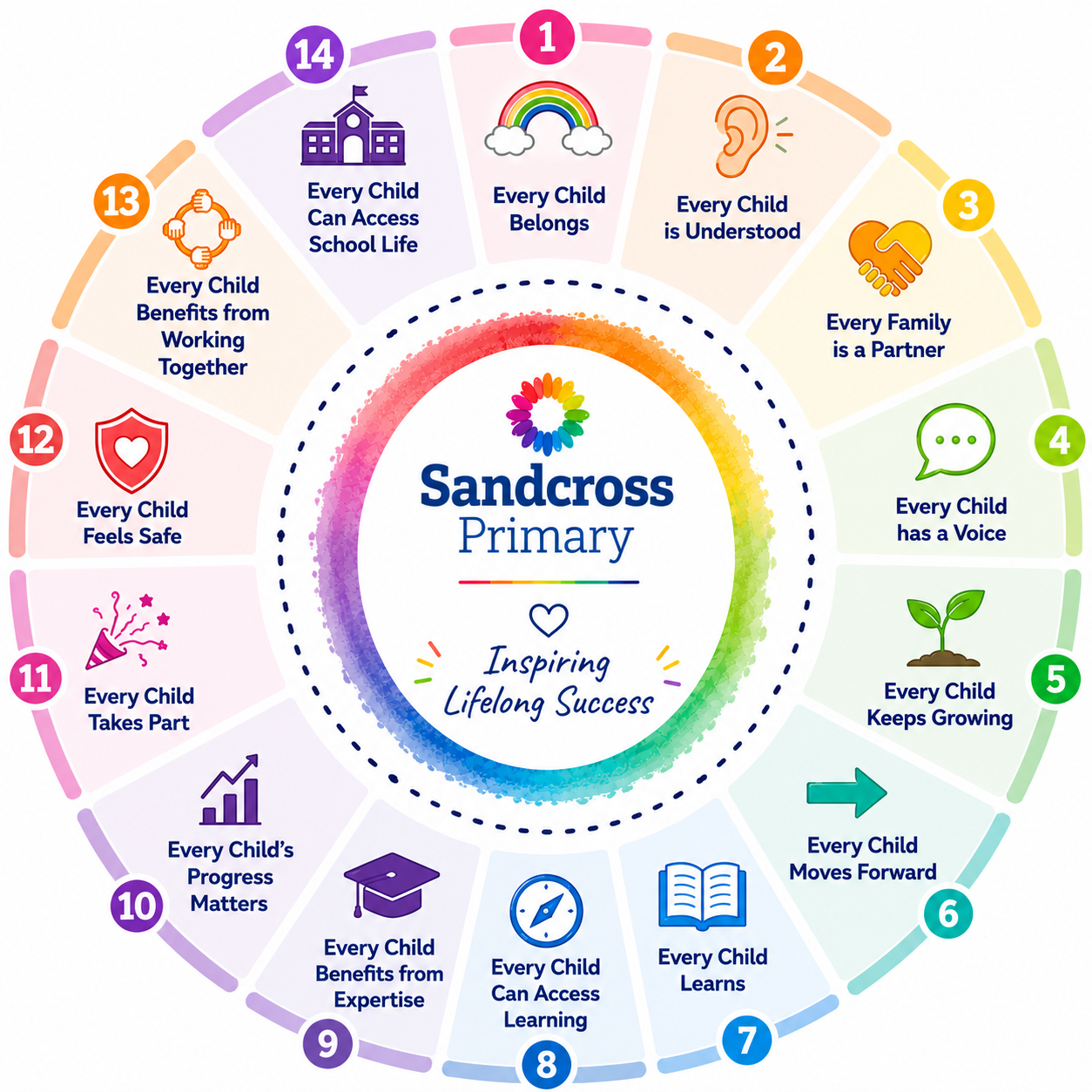
Every Child Belongs
At Sandcross Primary School and Nursery, we are committed to ensuring that every child feels valued, included and able to achieve their full potential.
We believe that every teacher is a teacher of every child and that high-quality, inclusive teaching is the foundation for meeting the needs of all learners.
Our inclusive support offer is based on a simple principle:
Every child receives the right support, at the right time, through the right pathway.
We recognise that children learn in different ways and that some may need additional support at different points during their education. Support is based on a child’s individual needs and the barriers they may be experiencing – a child does not need a diagnosis to receive support.
Our SEND Team
Inclusion Lead
Richard Bates
r.bates@sandcross.school
SENDCOs
Emma Anders and Munazza Pervaiz
senco@sandcross.school
SEND Administrator
Leyla Doughty
l.doughty@sandcross.school
School Office: 01737 245467
What types of SEND do we support?
Sandcross is a mainstream, inclusive school for children aged 3–11 and provides support across the four broad areas of need:
 Communication and Interaction
Including speech, language and communication needs and autism.
 Cognition and Learning
Including specific learning difficulties such as dyslexia, dyscalculia and dyspraxia, alongside moderate learning difficulties.
 Social, Emotional and Mental Health
Including difficulties with emotional regulation, anxiety, attachment, trauma and other mental health needs that may impact learning.
 Sensory and Physical Needs
Including hearing impairment, visual impairment, physical disabilities and medical conditions requiring reasonable adjustments.
I am concerned about my child – what should I do?
If you have concerns about your child’s learning, development or wellbeing, your child’s class teacher should normally be your first point of contact.
Teachers continually assess and observe children and can discuss your concerns, the support already available within the classroom and any appropriate next steps.
Where concerns suggest that a child may require further support, these can be considered through our Care Committee and SEND processes. Our SENDCOs may become involved to observe, assess and monitor a child and help determine the most appropriate support.
We also offer half-termly SENDCO drop-in sessions, giving parents and carers an opportunity to seek advice and discuss emerging concerns.
How do we support children?
High-quality Ordinarily Available Provision (OAP) is the starting point for every child.
Our classrooms use a range of inclusive approaches and reasonable adjustments, which may include:
-
visual timetables and visual supports;
-
adaptive teaching and scaffolded learning;
-
pre-teaching and overlearning;
-
practical, visual and multisensory approaches;
-
dyslexia-friendly resources;
-
sensory strategies and movement breaks;
-
calm spaces and self-regulation resources;
-
assistive technology or specialist equipment where appropriate.
Where a child requires support that is additional to or different from the provision ordinarily available within the classroom, further SEND support may be put in place.
The SEND Register and Support Plans
A child is placed on the SEND Register when evidence demonstrates that they require provision that is additional to or different from the Ordinarily Available Provision expected within a mainstream classroom.
Children receiving SEND Support have an Individual Support Plan (ISP).
Children with an Education, Health and Care Plan (EHCP) have an Individual Provision Map (IPM).
Support plans are reviewed at least termly and parents and carers are involved in agreeing outcomes, reviewing progress and planning next steps.
Decisions about SEND support are based on a child’s educational needs rather than diagnosis alone.
Working with Families
Parents and carers know their children best and are essential partners in their education.
Families are involved throughout the SEND process, including when identifying needs, planning support and reviewing progress. We aim to communicate openly, listen carefully and make decisions together.
Throughout the year we also offer opportunities including SENDCO drop-in sessions, Community Coffee Mornings, parent consultation evenings and other workshops and events.
Listening to Children
Every child deserves to be heard.
Children are encouraged to talk about their strengths, what they find difficult and the strategies that help them learn and feel successful.
Their views are used when planning and reviewing support, with the way we gather pupil voice adapted to suit each child’s age, communication needs and level of understanding.
Working with Other Professionals
Where appropriate, we work with external professionals and services to help us understand and meet children's needs. These may include:
-
Educational Psychologists;
-
Speech and Language Therapists;
-
Occupational Therapists;
-
Physiotherapists;
-
Specialist Teachers;
-
Paediatricians;
-
School Nursing Service;
-
CAMHS and Mindworks Surrey;
-
Children's Services and Social Care;
-
Family Support services.
Where parental consent is required, this will be discussed with families before referrals are made.
Inclusion and Accessibility
We want children with SEND to participate fully in all aspects of school life.
We make reasonable adjustments wherever appropriate to remove barriers to learning and participation, including within lessons, educational visits, clubs, sporting activities, performances and wider enrichment opportunities.
Our approach is to ask:
“How can this child take part?” rather than “Can this child take part?”
Surrey Local Offer
Surrey County Council's Local Offer provides information about the services and support available to children and young people aged 0–25 with special educational needs and disabilities (SEND), and their families.
For further information, please visit the Surrey Local Offer website.
SEND Advice Surrey (SENDIAS)
SEND Advice Surrey provides free, confidential and impartial information, advice and support to children and young people with SEND and their parents and carers.
Parents and carers can access information about their rights, education, health and care plans, and the support available to their child.
For further information, including contact details and how to access the service, please visit SEND Advice Surrey.
Specialist Equipment and Facilities
At Sandcross Primary School, we aim to ensure that children with SEND have access to appropriate equipment, resources and facilities to support their learning, independence and participation in school life.
Where specialist equipment or adaptations are required, our SENDCOs work with parents and carers, school staff and relevant external professionals to identify the most appropriate provision.
Recommendations from professionals, including Occupational Therapists, Physiotherapists and Specialist Teachers, are considered when identifying suitable equipment and adaptations. Where appropriate, the school liaises with the local authority and specialist services to explore how additional equipment or facilities can be secured.
These arrangements are reviewed regularly to ensure that the support provided continues to meet each child's individual needs.
Looked-After and Previously Looked-After Children with SEND
At Sandcross Primary School and Nursery, we are committed to ensuring that looked-after and previously looked-after children, including those with special educational needs and disabilities (SEND), receive the support they need to feel safe, included and achieve their full potential.
Our Designated Teacher for Looked-After and Previously Looked-After Children works closely with teaching staff, carers, social workers, the Virtual School and other relevant professionals to identify barriers to learning, coordinate appropriate support and monitor children's progress.
For looked-after children, a Personal Education Plan (PEP) is used to identify educational priorities, agree appropriate support and review progress.
Where a looked-after child also has SEND, our Designated Teacher and SENDCO work together to ensure that their PEP, SEND support arrangements and any Education, Health and Care Plan (EHCP) are considered together. This helps ensure that educational support is coordinated, individual needs are recognised and appropriate provision is in place.
We recognise the importance of stability, positive relationships, early intervention and working closely with carers, families and professionals to support children's educational achievement and wellbeing.
For further information, please see our Looked-After and Previously Looked-After Children Policy or contact our Inclusion Team.
Further Information
For full details of our SEND provision, identification processes, graduated approach, partnership with families, accessibility arrangements and external support, please read our:
You may also find the following useful:
Together, we can help every child belong, learn and flourish.
Accessibility Plan
SEND Information Report Sept 2026/27
Our SEND Information Report is reviewed annually and updated when necessary to reflect changes to our provision.
Last reviewed: September 2026
Next review due: September 2027
Children and Families Wellbeing Policy